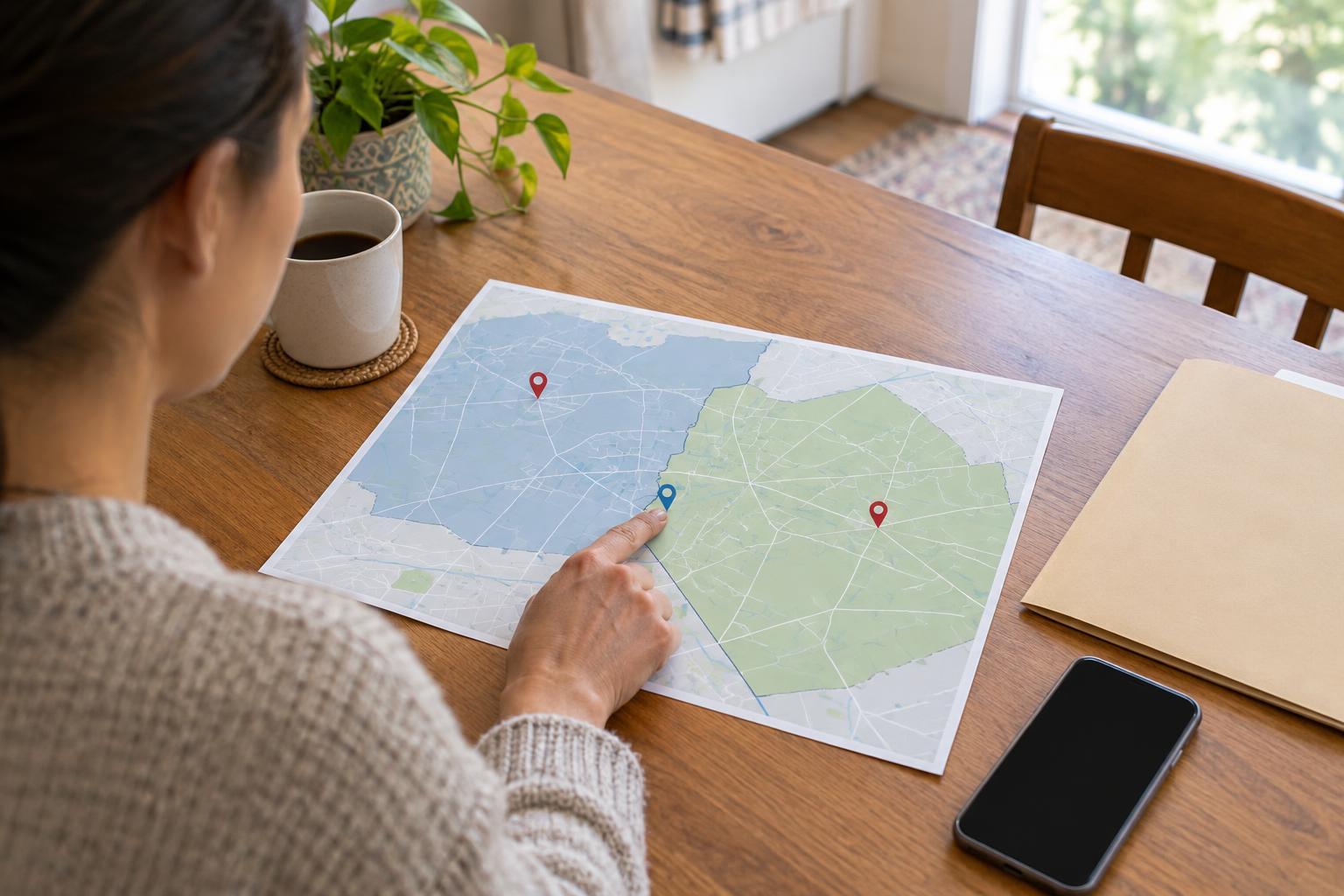
Distance and responsibility are different things
When you need help from a public service office, choosing the closest location seems sensible. It may have the shortest journey, but it may not be responsible for your address. Many services divide their work into geographic areas. An office might handle people who live within a particular district, municipality, school boundary or other defined area, even when another office is physically nearer.
A service area is the set of addresses or communities assigned to a provider or office for a particular purpose. Its boundary does not necessarily follow the route you would travel. A river crossing, a bus line or a short drive can make an office feel local without placing your home inside its assigned area. Understanding that distinction can save a wasted visit and help you reach the right team sooner.
Why service boundaries vary
Public services organize their work in different ways. Some use local administrative boundaries; others assign cases by postal address, neighborhood, school attendance area or the type of help requested. A walk-in desk may answer general questions from anyone while sending applications or ongoing cases to the office assigned to an address. The same building may also house several services, each with its own rules.
Boundaries can differ even between services that sound closely related. The office that answers a general inquiry may not be the one that keeps a case file or arranges an appointment. A central contact team may serve a wider area than any local branch. This is why an office directory should be read alongside the instructions for the specific service you need, rather than treated as a universal map.
Addresses near a boundary can be especially confusing. A shared postal town does not always mean shared service coverage, and two homes on the same road may fall in different areas. If an online lookup gives an unclear result, ask the service to confirm which office handles your full address.
How to check before you travel
Start with the official website or contact information for the service you need. Look for terms such as “find your local office,” “areas served,” “eligibility by address” or “where to apply.” Check whether the page refers to the service you are seeking, not just the building you plan to visit. An office listing may describe opening hours without saying who can submit paperwork there.
If there is an address lookup, enter the address in the format it requests and read the result carefully. Note whether it identifies a contact office, an appointment location or an area responsible for processing requests; those may be different places. If you call or message, a useful question is: “Which office handles this service for my address, and can I visit in person?” You can also ask whether an appointment is required and whether documents can be sent through another channel.
Use the contact details published by the service itself where possible. Search results, old leaflets and community discussions can help you identify questions to ask, but they may not reflect the service’s current instructions. If you are redirected, ask for the name of the correct office and the best way to contact it so you do not have to begin the search again.
What to do if the nearest office is easier to reach
An assigned office does not always mean you must travel to it. Some services allow phone calls, online forms, mailed documents or appointments at a different location. Others have firm requirements about where particular requests must go. Ask which parts of the process can be completed remotely or at a more accessible site, rather than assuming that the address assignment determines every step.
If travel, mobility, caring responsibilities, language or digital access make the assigned route difficult, explain the practical barrier when you contact the service. Ask what access options it offers and how to request them. Staff may be able to explain the available channels even if the nearby office cannot manage your case. For community-run services, check their own coverage rules as well; being close to a service does not necessarily mean you fall within its area.
Keep a simple record of what you learn
Before you submit documents or make a journey, write down the service name, the office or team you were directed to, the contact route and any appointment instructions. If someone confirms your assigned office, note when you asked and what they said. This can help you explain the situation if you receive conflicting directions later.
Share personal details only through the contact methods the service identifies for that purpose. A general question about coverage may need only your address or postcode, while a case-specific question may require a secure process to verify your identity. If the instructions remain unclear, say so and ask for the next concrete step. The goal is not to memorize every boundary; it is to confirm which team can handle your request before you spend time travelling or sending paperwork.